Customer Success · B2B SaaS

Churn is an invoice for poor quality. It arrives a year later, addressed to someone else.

Velista runs Customer Success at B2B SaaS vendors the way a factory runs quality. Gaps get settled at the kick-off rather than in an escalation, and value is measured in the customer's own metrics, in front of whoever will sign the renewal.

At a SaaS vendor selling price optimization to grocery and mass retail, NRR rose from about 90% to 120% in five years.

Let's talk about your challenges

A first 30-minute conversation, no strings attached. Reply within 48 hours.

Invoice Spare parts Amounts: example ItemQtyAmount (example) Discount granted1€8,000 Downsell1€24,000 Analyst tied upthree weeks3 wks€9,000 Lost reference1not quantifiable Total €41,000 Due: in 12 months Addressee: someone else To pay

Method

Anyone who has bought spare parts knows it from experience: the saving made on the order gets paid back later, in a rush, on another line of the budget. Joseph Juran formalized that calculation in 1951 as the cost of quality, splitting every quality-related expense across four cost lines. The model applies as it stands to a Customer Success budget. You decide to fund the first two, and the other two turn up on their own.

Total cost Minimum Failures Prevention and appraisal Cost Most SaaS vendors Quality level →
Four cost lines
Chosen

Prevention (chosen)

The kick-off exists to make decisions. Every gap between the customer's process and the product is written down, and for each one it is settled who adapts.

Appraisal (chosen)

Value is measured against a control group, in the customer's own metrics, and vendor and customer read it on the same dashboard.

Suffered

Internal failure (suffered)

Escalations, configurations rushed through in an emergency, the analyst pulled off three other accounts to put out the fire.

External failure (suffered)

The discount conceded at renewal, the downsell, the cancellation, and the reference the customer will never give.

Cost of qualityJuran model, 1951Rev. C

Sort last year's costs into the four lines.

No amount is recorded. Model: J. M. Juran, Quality Control Handbook, 1951.

~90% → 120%

NRR. Price optimization SaaS vendor, over five years.

×10

Expansion revenue. E-commerce scale-up, a team of more than fifteen people across three European markets, in under five years.

What Velista does

Customer Success and Account Management for B2B SaaS vendors

Velista builds the Customer Success function, or rebuilds it, so that the installed base becomes the vendor's first growth channel. Requests usually start from one of these situations.

  • A customer logs in every day and cancels anyway, because nobody ever turned that usage into a number in their own metrics.
  • Whoever signs the renewal discovers the value on renewal day.
  • The health score stays green as long as the sponsor is happy, and says nothing about what users actually do.
Customer Success in detail →

Velista also advises retail and e-commerce businesses on pricing strategy. Pricing →

Cases

Price optimization SaaS vendor, Tier-1 retailers

Situation

No Customer Success or Account Management function in place.

Intervention

The function was built from scratch (portfolio split, account follow-up processes, expansion strategy), then run internationally with a team of five CSMs and AMs on individual quotas.

Result

NRR from about 90% to 120% in five years.
Tier-1 sports retailer, an account at risk

The customer changes its commercial policy, and margin drops off its list of priorities although it accounted for 90% of the contract. Defending the old scope led nowhere, so the work started again from its new problems. Out of that came three cross-sells (matching competitor prices, analysing which promotions made sense, a won RFP to build its in-house pricing tool) and an upsell on an e-commerce test outside the original scope. Together they made up 500% of the churned revenue.

E-commerce scale-up, three European markets

Situation

A Customer Success team spread across France, Spain and the UK, confined to reactive work.

Intervention

A team of more than fifteen people to lead, and common processes to put in place across the three markets. The team then left reactive mode behind for a model steered by retention and expansion.

Results

Expansion revenue ×10, retention +10 points, NPS +20 points in one year.

Ways of working

Diagnostic

2 to 3 weeks

A costed assessment, line by line, followed by a prioritized roadmap. It is the shortest format, and it commits you to nothing afterwards.

Build

3 to 6 months, part-time

The function is built or rebuilt, from portfolio segmentation to team rituals, by way of metrics and tooling.

Fractional leadership

1 to 2 days per week

Velista runs Customer Success leadership until a permanent lead is hired or grows into the job. The role covers managing the team, steering the metrics and making the week's trade-offs.

Training and mentoring

One-off sessions or ongoing support

Sessions to train a team on a specific topic, or ongoing support for the person who has just taken on the role.

Formats in detail →

Tools

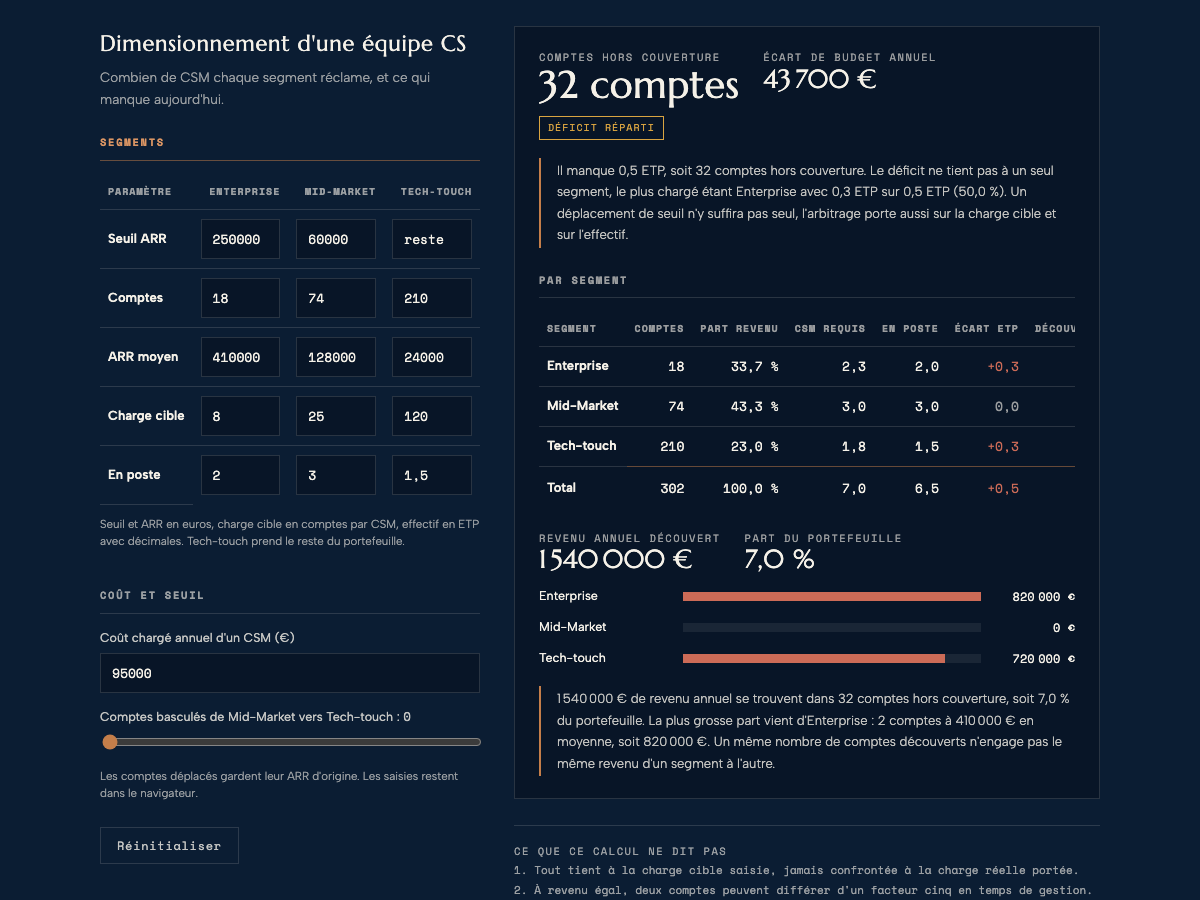
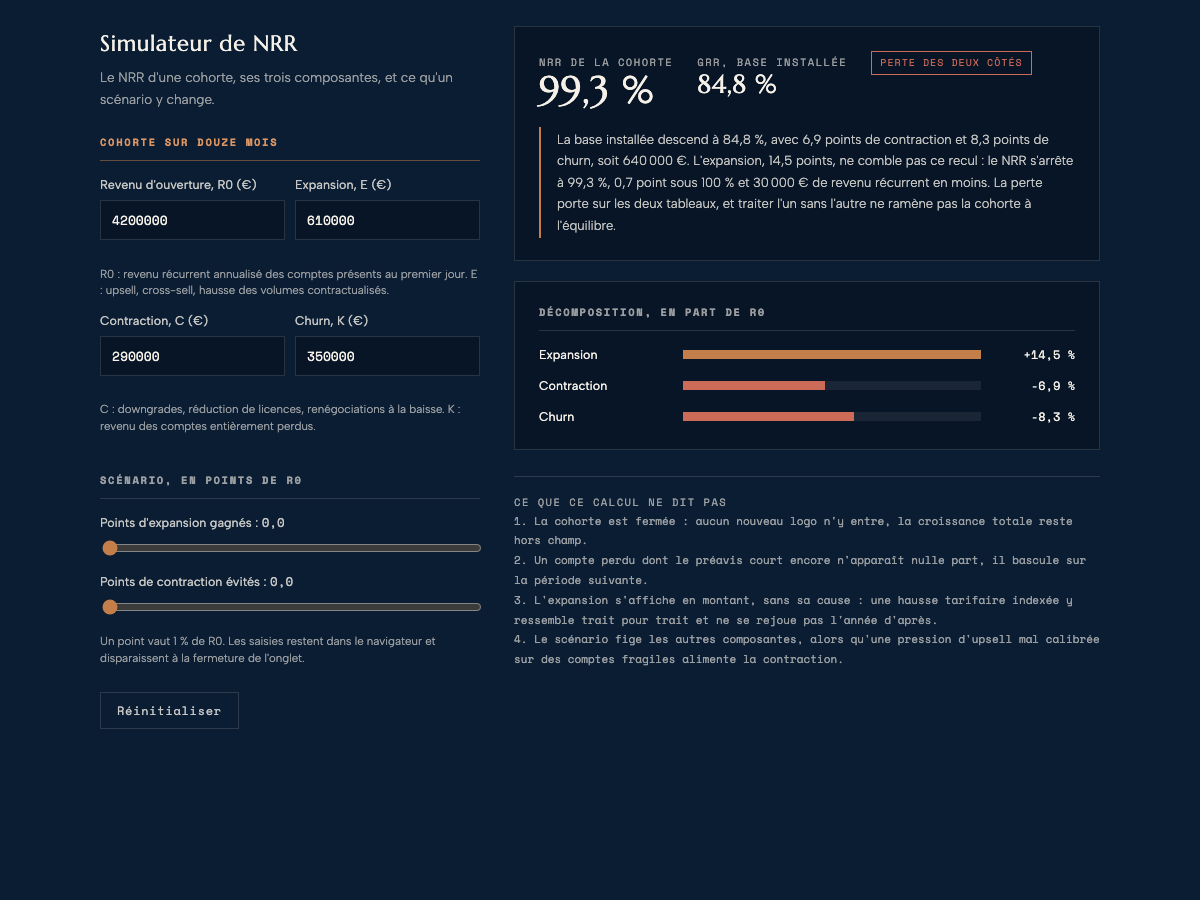
The eleven calculators used on engagements are open to anyone, with no sign-up. On the Customer Success side they cover NRR, team sizing, health score and churn risk; on the pricing side, among others, target buying price, price image, markdown and promotion P&L. See the tools →

Screenshot of the NRR simulator, as published
Screenshot of the CS team sizing tool, as published

Products

Some problems seen in the field call for a product rather than an engagement. The first is Argosfire, a wildfire monitoring service in France. See Argosfire →

Contact

Thirty minutes are enough to frame a retention or expansion issue and see whether there is work to do together.